
By Tom Morris
I met Wes Skiles in the early 1980’s. He more or less just dropped into my life. I was inside the cavern at Peacock Slough bagging some litter, when a diver came crashing to the bottom. He seemed to be having a seizure. As I reached for him, he righted himself, mimed a belly laugh, pointed to the bag of trash, and gave me the okay sign. Then, off he went. The diver, of course, was Wes. We met later in the parking lot and were soon diving together.
 It usually takes most of a day to go diving, but the underwater part only lasts for an hour or two, so it is important that you enjoy your dive buddy’s company. This is why long-term dive partners are usually good friends; without friendship the partnership doesn’t last. Diving is an adventure, and part of the way we fill our time together (surface interval, if you will) is with stories from our personal diving histories. The stories are retold so many times to new audiences that most dive buddies can tell their partner’s stories as well as their own. That is how it was with Wes and me. We are all divers, so I thought you might want to hear about Wes’ diving history and hear a few of his stories.
Wes grew up in Jacksonville, and learned to dive in his early teens. Like many Jacksonville divers Wes spent a lot of time offshore, and especially loved to spearfish. One day Wes and two buddies were diving out of sight of land, when their boat, which was anchored badly, was sunk by a big swell. They managed to climb up onto a large nearby buoy, and that was where they spent the night and the better part of the next day. They were beginning to despair when a fellow came along in a sixteen foot boat with a small outboard. The boater pulled alongside the buoy and asked, “Which way is Jacksonville?” They pointed west, at which point the lost boater started to motor away. Frantic yelling brought him back, and the man agreed to take them aboard. The boat was severely overloaded, but none of them would volunteer to remain on the buoy, or even abandon their dive gear. The ride back was tense, but they made it. This story would have been perfect for the popular last page feature in the old Skin Diver magazine called I Learned About Diving From That. Although, in this case, it should be I Learned About Anchoring From That.
Every diver in Jacksonville knew about the springs, and it wasn’t long before Wes headed over to check them out. Not surprisingly, after his first dive into a cave he was hooked. In those days Wes was too young to drive so he had to convince his mother to run him over to the springs on weekends and drop him off with his dive gear. He would set up his tent and wait for other divers to come along to buddy up with him. Talk about giving your son a long leash!
Around the mid 1970’s Wes started working in the Pro Dive Shop on Atlantic Boulevard, where he met Clark Pitcairn. Soon the two were diving together regularly. Clark soon changed the shop’s name to the Aquifer Dive Center, which strongly suggests he and Wes had a bad case of cave diving fever.
How high was their fever? Well, consider this. The late Dr. Chaplain, a cave diving heart surgeon who frequented the shop, owned Morgan Spring, but he would not let the two young men dive there. The temptation was too much, so they started sneaking in. The dives qualify as epic ordeal. They would park after dark across the river from the spring, put on their 104’s, climb down a steep 20 foot bank, swim across the river, climb up a similar embankment on the other side, walk a hundred yards to the spring basin, climb down the steep 20 foot basin walls, and finally get into the water. Soon they were exploring at 180 feet. After the dive they would reverse the whole process. Yes, they had the fever.
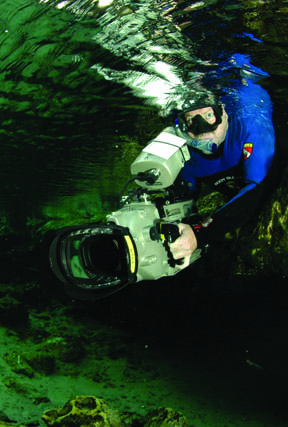
Wes took photography as an elective in high school, and this, along with surfing and diving, became a lifelong passion. When I look through my photographs I find that I have relatively few photos of Wes, because he usually carried the camera. In fact, it got to where he wouldn’t get into the water without a camera, even on ambitious exploration dives. He would often start on the swim to the end of the line knocking off photos, then drop the camera stuff, go explore, and pick up the camera gear on the way back, finishing off the film at deco.
Wes took this to the extreme during the 1987 Wakulla Project, when he mounted video cameras on his Aqua Zepp scooter, clipped still cameras to his harness, and then headed out to explore at over 300 feet deep. Dive opportunities were so precious and limited during the project that Wes did not have the luxury of dedicated photo dives. This made for some pretty severe task loading, but Wes pulled it off. Usually. On one memorable dive Wes mounted a video camera to the Zepp on a tall,strut so the lens looked over his shoulder. He counterbalanced the torquing effect of the camera with carefully placed lead. The problems started when the lead came loose, and the Zepp flipped upside down and floated to the ceiling. It took heroic effort to exit on the disabled scooter.
There have been a number of really good cave divers, but Wes had probably mastered the broadest range of skills of any diver I have known. One of those skills was surveying, and he could do it really fast. As fate would have it, Wes, Paul Heinerth and I got the last dive of the Wakulla Project. Right before we headed down, Dana Bryant, a DEP biologist, rushed over to me with some collecting gear and said they had to have more crayfish specimens. I reluctantly took the gear, and chased and collected crayfish at several spots along the way, which caused me to fall behind. I caught back up with Wes and Paul as they were tying onto the end of the line. They took turns laying out line from their Zepps and I followed behind, feeling increasingly anxious about my gas supply; I had used too much gas chasing those damn crayfish. When Wes pulled out a third reel, I showed him my pressure gauges. He said just stay close to me, and headed off with that last reel. When Wes finally tied off we were 4200 feet back. I wanted to dash for the entrance, but we had over 1500 feet of cave to survey. Wes and Paul surveyed like demons, while I concentrated on saving gas and staying real close to them. For years I wondered how good that rushed survey was, but darn if the Wakulla 2 data didn’t prove their survey to be spot on.
Wes was always on the cutting edge of cave diving. It was his idea to make a deco-chamber to take some of the pain out of long decompressions, which could be burdensome in the days before nitrox and the regular use of oxygen for decompression. My kids had a six foot diameter cattle trough they used for a swimming pool, and Wes persuaded me to swipe it from them and help him put it into the Peacock cavern. There is a photograph of it on the cover of an old Underwater Speleology. As we filled the trough with air we began to worry that we might collapse the cavern ceiling. But, it worked great and was the model for subsequent chambers installed elsewhere. The tub finally ended up in Cathedral Canyon, where it is rusting away today. Incidentally, Woody Jasper engineered what was probably the ultimate deco-tub. He rented a small Dempsey Dumpster and welded in brackets for bunk beds. We put it in Bird Sink, and named it the Bird Sink Hilton. We even had a full-blown Thanksgiving dinner in that dumpster, in our beds.
Wes was involved in the development of Florida side-mount diving. He and a few others originally looked for ideas by studying photographs of British rigs in books like The Darkness Beckons. But, the British style didn’t work too well in Florida; the conditions and diving demands are so different. Through trial and error their side-mount rigs slowly evolved into the more or less standard style we use today. Woody Jasper commented one day that side-mount rigs would help keep him diving into old age because he would only have to carry one tank at a time to the water. I just saw that PADI is now teaching side mount-diving to the masses, with that being one of the cited benefits.
Wes was also on to the concept of a long hose quite early. He went out and made up a batch of the first seven foot hoses from the tubing used on CO2 canisters at soda fountains. I still use mine, but I have to admit my dive buddies worry about its age.
Divers tend to form small groups based on geography, age, chance, and interests, and Wes and his friends were no different. We had a “tribe” and within it we were somewhat competitive. One manifestation of this was comparing how much air we had left after a dive. One day, after we did the “How much air you got left” bit, Woody Jasper said, “Let me see your pressure gauges.” I can’t remember who cheated the most. Surely, it had to be Wes. Certainly, not me! But Wes really didn’t have to cheat. He was extraordinarily athletic underwater. I was made painfully aware of this during a series of dives we made into Aerolito de Pariso on Isla Cozumel. The swims were long. One fault-controlled passage, the Road to Chankanab, went straight as an arrow for over three thousand feet. To my dismay, Wes would slowly pull away from me, and use less air doing it.
Meeting Wes was one of my lucky moments. I have lost track of the cool paid vacations I have been on to help Wes film or explore. He once said, “You lucky bastard, you get to do the fun part, actually making the films. I have to do the hard part, getting the support and money together, making it all happen.” It would sometimes take Wes several years to get a new project going. There are limited funds for documentaries and the many would-be filmmakers. It is a testament to Wes’ ambition and creativity that he had worked his way right to the top. I was with Wes when he made his first film, a small thing called In Search of the Lens. The two of us went over to the Bahamas with a small housed video camera and two video lights. Simple. But over the years, as the shoots became more ambitious, the equipment grew exponentially. One month-long shoot for National Geographic in the Yucatan Peninsula is particularly memorable, as miserable experiences usually are. Wes was shooting video as well as stills, and the pile of equipment was enormous; we must have had more than fifty big cases of gear. We moved locations frequently, and had to load and unload a large truck with high wooden rails each time. With each move we also had to set up a new equipment station, crank up generators, charge an assortment of batteries, fill tanks, fix broken equipment, make meals, set up camping gear, plan the next day’s shoot, go to bed late, go shoot, and then do it all over again. Eventually Sylvia, our young Production Assistant, approached Wes and said she thought the crew was worn out and needed a day off. Wes’ reply: “Hell, my boys wouldn’t know what to do with a day off.”
The IMAX shoot of Journey into Amazing Caves in the Yucatan was also memorable. The IMAX camera shoots 70mm film, and is huge, especially with its housing. It actually took a winch to get it in and out of the water. A roll of film cost $3000, including developing and printing, and runs through the camera in three minutes. So, it costs $1000 per minute to shoot. There is no instant feedback, like we get with modern video; the film had to be mailed back to the USA to be processed. Later you would get a call reporting on exposures and such. At first we were all freaked out about maybe being the one to blow a $3000 shot, but we eventually got used to it.
Wes wanted to film Hazel Barton, our vivacious star, swimming through a particularly beautiful stretch of cave, and he wanted to light it with surface supplied lights. But, it was too far back for our 330 foot power cables. Wes’ solution was to drill a small diameter hole into the roof of the cave, and feed four cables in near the “set.” The plan was to feed the ends of the four cables barely into the cave. Then divers would swim to the cable ends, tug on them, and make four neat piles as the rest of the cable was fed down the hole. Later the cables would be stretched out to their lights. However, the surface tenders felt an imaginary tug and fed all the cable down before the divers got there. What an unbelievable mess; a quarter mile of cable in one huge pile. Our spirits were crushed. But along came Gary Walton to the rescue. He went back there and spent several hours untangling the mess, all by himself.
I believe it was on the IMAX shoot that Wes coined his dreaded call to work: “Dive, dive, dive.” Or, alternatively: “Time to make the donuts,” which later morphed into “Time to make the babies.”
Wes was not shy, and on almost every project he would do something that would elicit a collective “I can’t believe he did that.” One time we were filming the story of Linda, a woman who was rescued after being lost in an underwater cave for six hours. There were a number of policemen involved in the actual incident, and they were around for the reenactment. At one point three of them were killing time and leaning against Wes’ van. Out of the blue Wes yells, “HEY, GET THE HELL OFF OF THAT VAN.” The cops leapt up like they had been tased. Then Wes, with a sideways grin, said “I always wanted to do something like that.”
Wes’ career accomplishments are varied and include the IMAX film mentioned above, as well as National Geographic magazine and film specials, television shows such as Rescue 911, Hollywood movies, such as The Cave, and Discovery Channel’s Time Warp. But, it is probably safe to say that Wes derived the greatest satisfaction from his Water’s Journey documentary film series.
These films follow the journey of water above and below the Florida landscape, through rivers and swamps, into deep underwater caves, and even through sewer pipes. Along the way Wes shows how our activities affect our water resources. He showcased cutting-edge techniques that promise to lessen impacts from agriculture and urban development. But, more importantly, Wes showed how small but important changes in the way ordinary citizens do things can lessen our collective impact on the health of our water. The series was crafted to entertain as well as educate, and it had to be gratifying for Wes to know that teachers in Florida have shown these films to an entire generation of middle and high school students.
Wes, through his exploration, photography, documentary films, and political activism, was probably more influential than anyone else in raising our awareness of his beloved Florida springs and the problems that now threaten them. When Wes first started diving in the springs, they were in pretty good shape. But by the 1990’s the delayed effects of over-pumping and widespread groundwater pollution were gradually becoming apparent. Wes’ response was a tireless campaign to direct protection efforts beyond the springs themselves and into their watersheds, where the problems originate. His campaign of education and reform ranged from local garden clubs right up to the office of the governor. He was truly a champion of the aquifer.
Wes’ last big filming project was the joint NOVA-National Geographic Blue Holes of the Bahamas project, which showcased scientific studies taking place in Bahamian caves. In light of what was to come, it was so great that our little group of friends was able to spend so much time together. Wes was very happy to have his son Nathan along on the crew. So were the rest of us; we had a new victim for our stories, lies, and practical jokes. Wes even put Nathan on the cover of National Geographic. Woody Jasper once commented, “The only reason anyone even knows who we are, is because we have a publicist.” He was referring, of course, to Wes.
Wes always had several projects in the works. On the day he died, he was filming unpredictable bull sharks off the southeast coast of Florida. That morning, offshore conditions were rough, and there was debate as to whether or not they should go out. Wes’ reported comment on the situation comes as no surprise to those who knew him: “Well, the waves are big and rough, the currents will be strong, and it looks like rain. Sounds like the perfect day to go film sharks.”
Photo of Wes shooting the big hi def camera by Nate Skiles.