
 By Paul Heinerth
Wes, my old friend…Where do I begin to tell my story of the man known as Wes Skiles?
The year was 1976. While still at the University of Florida, I first heard of Wes Skiles at Ginnie Springs. He was one of the many divers hanging out there. The property had just been purchased and a gate was being welded at the entrance of the cave entrance of Ginnie Spring. Sometime the following year, veteran cave diver Sheck Exley had referred to Wes as the new cave diving kid from Jacksonville that was “a pretty good cave diver.”
A few miles from Ginnie Springs was the Branford Dive Center (BDC) on the Suwannee River by the bridge in Branford. The dive shop had been (and still was at the time) the center of the cave diving world. The BDC building survived many river floods and was the only dive shop where one could actually “dive” in the shop (during flood times). By 1980, Wes was managing the BDC. One of my fondest memories was after he and his wife Terri had moved into an old farmhouse nearby. Wes was up high on a wobbly stool trying to hang something and Terri, trying to steady the stool, just reached up and pinched him (I can’t tell you where…) and he almost fell off his perch. Most men would have been angry. He just laughed it off. What a matched couple, I thought. Throughout the 80’s stopping at the BDC was always a must. It was the best way to hear about what Wes was up to and who was diving with whom and where. A couple of years ago, the BDC building was demolished and taken away just as I was crossing the bridge. I saw through my rearview mirror as the heavy machinery knocked it down. A lot of history was gone in an instant. I did not have a camera ready but Wes would have! While Wes was busy teaching cave diving and running the BDC, I was doing the same at my own dive store, Scuba West, in Hudson. We often shared stories only dive store owners and managers would understand. I lost track of Wes for a few years after he left the BDC. He was off making a living with his camera like his wild adventure in Australia where he and his team were buried alive. His camera never stopped recording the event. The result was a great adventure documentary.
Our paths crossed again for the 1987 Wakulla Spring project. It was a rocky start. I was invited to join the group and was told to be there at 8 a.m. on an October day. I was there but no one else had arrived. This was before cell phones… Eager to “check out” the spring and unaware of the diving protocol, I got into the water with my buddy Steve, a local cave diver. Once back on land, I came across Wes who had arrived while we were underwater. To say he was mad was an understatement; he was pissed. He and Dr. Bill Stone were the two guys in charge. Wes almost sent me home, right there and then. Surviving that verbal onslaught, I was more determined to stay, as I smelled the potential of a great adventure. Wes quickly put Steve and me to work building shelves, sweeping floors and whatever else that needed to be done. I had to redeem myself as I always wanted to work with the boy from Jacksonville. The Wakulla Springs expedition was a massive project. The two project goals were a detailed map and a documentary film. With Wes’ guidance and expertise, I was able to use the Benthos underwater camera from National Geographic, which was mounted to the bottom of my scooter. In addition I ran a 16 mm movie camera on top of the diver propulsion vehicle. It was an interesting task load along with driving the scooter at 300 ft. deep. Wes gave me some tips and he sure made it sound like it was going to be easy. A book was published from our efforts at Wakulla Springs. Several of the pictures I shot made it into that book thanks to Mr. Skiles. The last dive of that project was done by Wes, Tom Morris and me. We knew it was the last chance for a “big” dive as the decompression habitat was coming out of the water the next day. At this point we had finished our tasks of taking pictures, collecting data and water samples. This dive was going to be a fun dive and we all gave each other high fives under the water and got all of our reels with knotted lines and off we went exploring. We emptied out four reels. Wes and I were nearly 4000 feet back at a depth of 300 feet when we decided to discuss who would put the last reel into the tunnel. I said” here you do it” and he said, “no, you do it.” I said, “No, no, you do it”. He then said, “No, no, no, you do it;” so I did. Thank you again my friend. Before our big dive, the end of the line was around 2100 feet in the “B” tunnel. After our dive, the surveyed tunnel was just short of 4200 feet. It was an epic dive, my longest and deepest open circuit dive and it was with the best dive buddies possible, Wes and Tom.
Life went on and my dive store kept me very busy as well as raising my son. Wes and Terri soon followed suit by having a son and then a daughter. We would see each other at Ginnie Springs and compare fatherly duties, cave explorations, Star Trek movies, spear fishing stories, and catch up on any film work or project that Wes was into. We hooked up again for the Wakulla 2 project of 1998-99. He was there as the lead man for National Geographic. His duties were too numerous and he did not have the time to go “explore”. Remembering our epic dive of the 1987 project, we discussed these new dives where he was surely missed. I recall telling Wes of what I saw on those dives and could see the twinkle in his eyes and his desire to be part of the exploration team. Even with his many duties, Wes still found time to keep the dive team’s morale up. Using some sort of metal contraption, he was able to whip up some delicious meals from the campfire, tell jokes and play his guitar. I was always surprised by all his talents, including learning the guitar on his own.
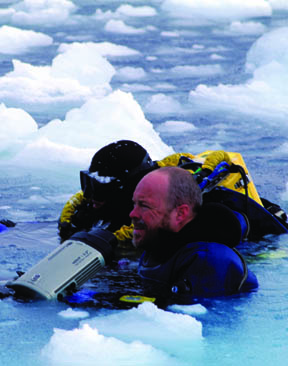
Within a year Wes invited my wife and me on his newest project to Antarctica. It was a grand expedition on which we got to dive into iceberg caves. On one of the early dives, Wes’ dry suit flooded. In the typical Skiles fashion, he says, “I will just get this one more shot and then I will get out.” Wes was unfamiliar with diving in extreme water temperatures and he went into hypothermia. He was safely guided back to the boat and rushed into a warm shower. No matter what, he always got the shot. Because we had rebreathers, we were able to do an unplanned 3-hour dive in extreme currents and tidal changes. This would have been impossible on open circuit due to the sub-freezing water temperature. On this particular dive, with the high definition underwater camera, we filmed a living garden under a grounded iceberg. There were a great many cave passages carved into this iceberg. The walls and ceiling were made of white and blue ice and the floor was littered with rocks covered in a myriad of life. The tide changed while we were 800 feet back in the icberg tunnel. Exiting this dive turned out to be a swim for our lives. Wes had the big camera and I could see he was no longer making forward progress against the incoming current. I knew he would not abandon the camera until the last possible second so I dropped back down with him so that we both could kick out together, one on each side of the camera. We finally made it out. It was one my most unique dives. Oh, yes, the iceberg fell apart a few hours after our exit… Terri Skiles once told me that many divers have expressed their gratitude for having their biggest dive of their life with Wes as their buddy. I am very happy to say I did, twice! Thank you again my old friend.
After Antarctica, we continued to work and dive together. We had some great times together that included alligators, ugly fake teeth, make-believe underwater monsters in a BBQ cooking contest and selling football programs for a Gator game in Gainesville at the University of Florida. We did T.V. episodes and a National Geographic project in a Yucatan cave…the adventures are too numerous to list in one article.
Then it was the first “Water’s Journey” documentary film, here in Florida. It was his best work and won multiple awards. It highlighted his talent and dedication to protecting the fresh water resources of Florida. In addition, Wes taught me more on the high definition camera and let me do a lot of the videography. It was an exciting time for me as I always enjoyed working with Wes.
In the summer of 2004 it was back again to the Yucatan for the movie “The Cave.” I would not have missed this experience for the world as I got to work closely again with Wes as his fiber optic underwater cable handler. This involved anticipating Wes’ every move to avoid jerky camera movement and retakes. We were a great team together and Wes expressed his gratitude to me. He always knew when to praise a deserving team member. Wes had a group of us he called his dream team. He surely knew how to get the best and the most out of each of us.
Unfortunately, we did not work together much after my divorce in 2004. I was on cloud nine upon receiving his call in 2009 to help him for the Bahamas National Geographic project. Unfortunately, due to budget restraints, I did not participate. We were slated to work together again in late 2010 documenting William Truebridge’s attempt to break the 100-meter breath hold dive. Damn it Wes, why did you leave? We were just about to ramp up and work together again. You know I would have worked with you anywhere…I could go on and on about his sense of humor, his never-ending source of energy, his need to get that last shot, his sense of fairness, and his sixth sense about cave diving. He was a good man. I am honored and very proud to have spent so many great adventures with him. It will take many to fill the void he has left.
Photo of Wes and Paul at the surface in the icy waters of the Ross Sea in Antarctica by Jill Heinerth